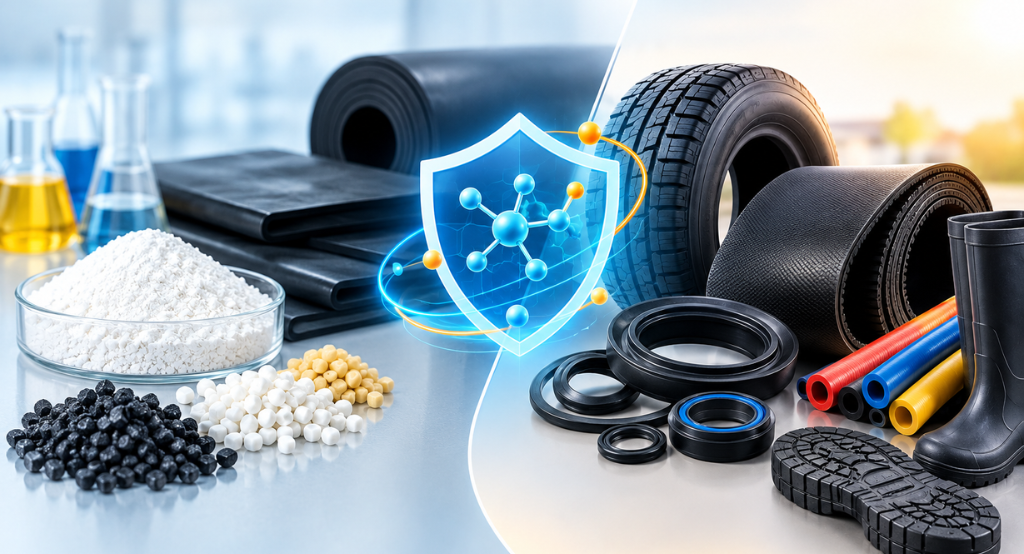
Rubber products are exposed to heat, oxygen and mechanical stress during manufacturing and use. These factors can cause oxidation, discoloration, cracking and loss of elasticity. Antioxidants in rubber processing help slow degradation, preserve physical properties and improve product durability.
For rubber manufacturers, selecting suitable stabilizers is essential for maintaining product quality, reducing premature failures and achieving consistent production results.
What Are Antioxidants in Rubber Processing?
Rubber antioxidants are chemical additives that help protect rubber compounds against oxidative aging. They work by interrupting oxidation reactions or decomposing oxidation by-products, depending on their chemical structure.
The right antioxidant system can help maintain tensile strength, flexibility and appearance during processing, storage and end use.
How Do Stabilizers Improve Rubber Performance?
Antioxidants support rubber manufacturing in several ways:
- Thermal stability: Helps reduce oxidation-related degradation during processing and high-temperature service.
- Mechanical property retention: Helps preserve elasticity, tensile strength and elongation.
- Longer service life: Slows premature aging under suitable operating conditions.
- Appearance retention: Certain stabilizers help minimise unwanted discoloration in light-coloured and coloured rubber products.
These benefits are relevant to manufacturers of rubber tubing, conveyor belt covers, industrial seals, footwear components and latex-dipped products.
Types of Antioxidants Used in Rubber Manufacturing
1. Amine antioxidants: Commonly used in applications such as tyres and industrial rubber compounds, these additives provide effective oxidative protection. Some grades may cause staining or discoloration.
2. Phenolic antioxidants: Selected for oxidative stability and, depending on the grade, colour-sensitive applications. Styrenated Phenol (SP), for example, is used as a non-staining, non-discoloring antioxidant in dry rubber and latex compounds.
3. Phosphite antioxidants: These generally act as secondary antioxidants by decomposing hydroperoxides. They can complement primary antioxidants and improve processing stability in suitable formulations.
Combining compatible primary and secondary antioxidants can provide broader protection, depending on the rubber formulation and operating conditions.
How to Choose the Right Rubber Stabilizer
Manufacturers should evaluate these factors before selecting a stabilizer:
- Rubber type: Natural rubber, synthetic rubber and latex compounds have different formulation requirements.
- Processing conditions: Mixing temperatures, curing and exposure to oxygen influence additive performance.
- End-use requirements: Heat, sunlight, ozone and mechanical stress may require different protection strategies.
- Compatibility: Dispersion, migration, blooming and interaction with other ingredients affect performance.
- Colour and compliance: Product appearance and application-specific regulatory requirements must be considered.
Laboratory testing and accelerated aging tests can help determine whether a stabilizer meets the required performance specifications.
Conclusion
Antioxidants are important additives in rubber processing because they help slow oxidative aging, preserve product properties and support longer service life. Choosing the right stabilizer requires evaluating the rubber type, processing conditions, colour requirements and intended application.
Adishank Chemicals offers Styrenated Phenol (SP) for dry rubber and latex compounds, along with phosphite-based additives for relevant industrial applications. Explore the Styrenated Phenol product page or contact Adishank Chemicals to discuss your formulation requirements.
Frequently Asked Questions
1. Why are antioxidants used in rubber processing?
Antioxidants slow oxidation-related degradation and help preserve rubber’s elasticity, strength and durability.
2. Which antioxidants are commonly used in rubber manufacturing?
Amine and phenolic antioxidants are commonly used for oxidative protection, while phosphite antioxidants can provide complementary secondary stabilization in suitable formulations.
3. Can antioxidants extend the service life of rubber products?
Yes. They can slow oxidative aging and help maintain physical properties, although results depend on formulation and service conditions.
4. What is the difference between an antioxidant and an antiozonant?
Antioxidants primarily protect against oxidative degradation, whereas antiozonants specifically help protect rubber against ozone-induced cracking.
5. What is Styrenated Phenol used for in rubber?
Styrenated Phenol (SP) is used as a non-staining, non-discoloring antioxidant in dry rubber and latex compounds, including selected white and coloured rubber applications.