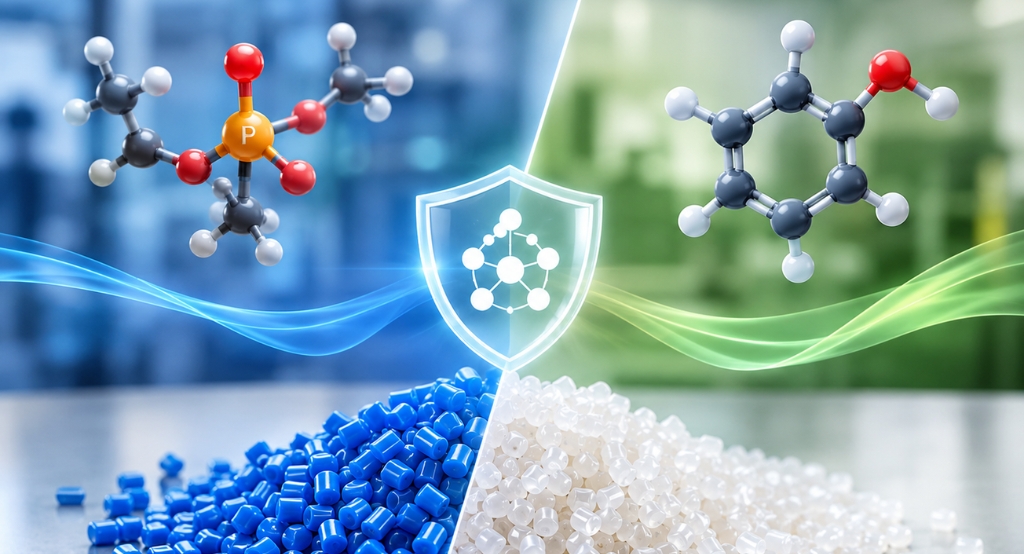
Polymer processing exposes materials to heat, oxygen and mechanical stress, which can trigger oxidation and affect colour, melt stability and performance. Antioxidants help control this degradation and improve polymer stability during processing and service life.
But when it comes to phosphite vs phenolic antioxidants, which one should manufacturers choose?
Quick Answer
Phosphite antioxidants are mainly secondary antioxidants used to decompose hydroperoxides formed during oxidation, making them particularly valuable for processing stability and colour protection.
Phenolic antioxidants are mainly primary antioxidants that react with free radicals and help provide long-term thermal and oxidative stability.
For many polymer systems, using both together provides more complete protection because their mechanisms complement each other.
Phosphite vs Phenolic Antioxidants
| Feature | Phosphite Antioxidants | Phenolic Antioxidants |
| Type | Secondary antioxidant | Primary antioxidant |
| Main function | Decomposes hydroperoxides | Controls free radicals |
| Key benefit | Processing & colour stability | Long-term oxidative stability |
| Particularly useful for | High-temperature processing | Long-term protection |
| Common approach | Often combined with phenolics | Often combined with phosphites |
When Should You Choose Phosphite Antioxidants?
Phosphites are especially useful during extrusion, injection molding, compounding and other high-temperature processes. They help reduce oxidative degradation and support melt and colour stability.
Common phosphite antioxidants include Triphenyl Phosphite (TPP), Diisodecyl Phenyl Phosphite (DDPP), Diphenyl Isodecyl Phosphite (DPDP), Diphenyl Isooctyl Phosphite (DPOP) and Tris(nonylphenyl) Phosphite (TNPP). Adishank offers these phosphite products for industrial applications.
When Are Phenolic Antioxidants Used?
Phenolic antioxidants are primarily selected when the formulation needs better resistance to oxidative degradation and long-term thermal stability.
They work by interrupting free-radical oxidation reactions, helping protect the polymer from continuing degradation.
Should You Use Phosphite or Phenolic?
For many applications, this is not an either-or choice.
A primary phenolic antioxidant can control free radicals, while a secondary phosphite can decompose hydroperoxides. Together, they can provide protection during both processing and long-term use.
The right combination depends on the polymer type, processing temperature, application, colour requirements and overall formulation.
FAQs
What is the main difference between phosphite and phenolic antioxidants?
Phosphites mainly decompose hydroperoxides, while phenolic antioxidants mainly control free radicals.
Are phosphite antioxidants primary or secondary antioxidants?
Phosphite antioxidants are generally classified as secondary antioxidants.
Are phenolic antioxidants primary antioxidants?
Yes. Phenolic antioxidants are generally classified as primary antioxidants.
Can phosphite and phenolic antioxidants be used together?
Yes. Their complementary mechanisms make them commonly suitable for combination antioxidant systems.
Which antioxidant is best for polypropylene?
There is no single best antioxidant for every PP formulation. The choice depends on processing conditions, end-use requirements and the desired level of stabilization.
The right antioxidant is not simply about choosing phosphite or phenolic. It is about selecting the right stabilization system for your polymer, processing conditions and performance targets.
Adishank Chemicals offers a range of phosphite antioxidants including TPP, DDPP, DPDP, DPOP and TNPP, along with Styrenated Phenol (SP), supporting polymer, rubber and other industrial applications.
Looking for a reliable antioxidant solution for your polymer formulation? Connect with Adishank Chemicals to identify the right product for your application.